
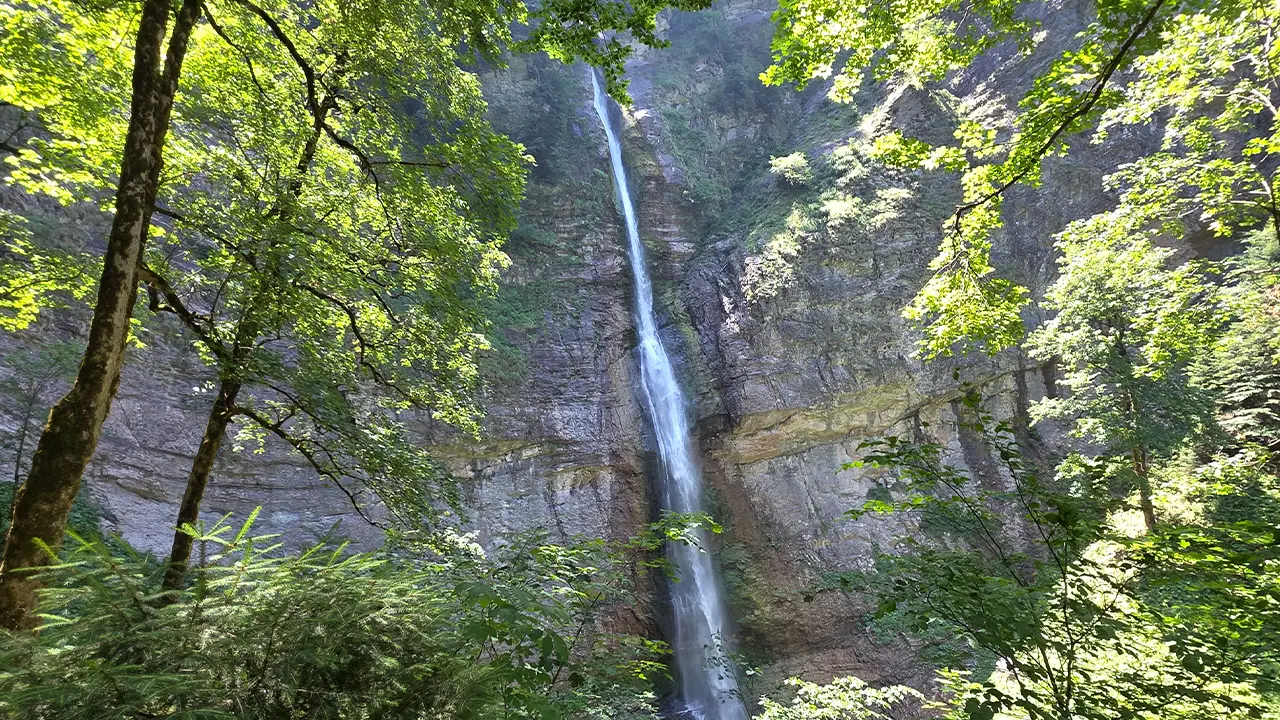

Perucica (Perućica) is a strictly protected primeval forest inside Sutjeska National Park in Bosnia and Herzegovina, and it is one of the best preserved old-growth forests in Europe. You cannot walk into it alone: entry is legally restricted to visitors accompanied by a licensed national park guide. This Perucica guide covers exactly what the Perucica primeval forest is, the access rules that trip people up, the hikes and viewpoints, and how to plan a visit that actually happens rather than one you get turned away from at the forest edge.
What Is Perucica Primeval Forest?
Perucica is a strict nature reserve sitting in a valley between the peaks of Maglic, Volujak and Snjeznica in the southeast corner of Bosnia and Herzegovina, close to the Montenegro border. The strictly protected core covers 1,434 hectares, while a wider protected buffer covers around 3,091 hectares. According to Wikipedia, the Perucica forest reserve is 6 km long and 1 to 3 km wide, with elevations from about 600 m in the Sutjeska canyon up to around 1,800 m on the slopes of Maglic, the highest mountain in Bosnia and Herzegovina at 2,386 m.
The forest is often called “the lungs of Europe.” Its age is frequently given as around 20,000 years, meaning it has developed since the last Ice Age with no logging or clearing. Individual trees are the real headline: the dominant species are European beech, European silver fir and Norway spruce, with sycamore maple, wych elm and ash mixed in. Some trees are over 300 years old, the oldest beeches exceed 500 years, and Perucica is famous among dendrologists as the place where Swiss researcher Hans Leibundgut measured a Norway spruce of 63 m in 1954, long cited as the tallest of its species recorded in Europe. The reserve holds over 170 species of trees and shrubs and more than 1,000 species of herbaceous plants.
For the science-minded, Perucica is a carbon and biomass heavyweight. The UNESCO World Heritage Centre tentative-list text notes standing stock that “exceeded 1.000 m3 per hectare” with tree heights over 50 m, and field researchers have recorded up to 1,870 m³ per hectare on small plots. A 2024 study by Motta and colleagues, “The largest European forest carbon stocks are in the Dinaric Alps old-growth forests” (Carbon Balance and Management), reports “a very prominent C stock in both study areas (507 Mg C ha−1), concentrated in a few large trees (36% of C in 5% of trees),” the highest such stocks recorded in Europe. Deadwood alone runs around 406 m³ per hectare.
Is Perucica a UNESCO World Heritage Site?
This is the single most misreported fact about Perucica, so let us be precise. Perucica is not an inscribed UNESCO World Heritage Site. Per the UNESCO World Heritage Centre, it was added to Bosnia and Herzegovina’s Tentative List on 23 May 2017 under the name “Strict Nature Reserve – Primeval forest ‘Perućica’,” nominated under natural criteria (vii), (ix) and (x). A tentative listing is a candidate stage, not an inscription.
It is also not part of the transnational “Ancient and Primeval Beech Forests of the Carpathians and Other Regions of Europe” World Heritage site. That serial property includes beech forests across a dozen or more European countries, but Perucica in Bosnia is not one of the inscribed components. So when a blog or tour listing calls Perucica “UNESCO-protected,” treat that as marketing shorthand rather than fact. The genuine protection status is national: it is a strict nature reserve managed by the Public Institution National Park Sutjeska, classified at the highest protection level (IUCN Category Ia), inside a national park established in 1962 (IUCN Category II). It was first set aside for science in 1952 and placed under state protection as a reserve in 1954.
Is It Really One of Europe’s Last Primeval Forests?
You will read everywhere that Perucica is “one of the last two primeval forests in Europe,” a claim even repeated in the UNESCO tentative-list text alongside Bialowieza on the Poland and Belarus border. The honest version is more nuanced. Perucica is one of the largest and best-preserved old-growth forests in Europe, and it is genuinely exceptional. But it is not literally one of only two. Romania’s Făgăraș Mountains hold roughly 10,000 hectares of old-growth forest, described by the Czech University of Life Sciences (Prague) REMOTE project as likely the largest area of old-growth forest in the entire EU. Austria has old-growth in the Kalkalpen, and the Dinaric Alps alone contain several protected old-growth reserves (Lom and Janj in Bosnia, Biogradska Gora in Montenegro). What makes Perucica special is its scale, its intact structure, its towering trees and its complete food web, not being one of a final pair. It is also worth noting it is a primeval old-growth forest, not a “rainforest,” despite the popular label.
Wildlife in Perucica
The reserve supports a full complement of large mammals: brown bear, wolf, Balkan chamois, roe deer, wild boar, fox and badger, with rarer wild cat and lynx also recorded. Birdlife is a highlight for specialists, with nine species of woodpecker present in the wider park, representing most of Europe’s woodpecker species. Be realistic about sightings: large mammals are shy and the dense canopy limits visibility, so most visitors see tracks, droppings, birds and insects rather than bears or wolves. That is normal, and a sign the animals are behaving as wild animals should.
Access Rules: The Part Most People Get Wrong
A licensed guide is legally mandatory. The national park administration is explicit that any visit to Perucica is forbidden unless it is announced in advance, approved, and accompanied by authorized park staff. You cannot legally enter the reserve alone, and the trail into the forest is deliberately unmarked. This rule is enforced.
There is a crucial distinction between looking and entering. The viewpoints that overlook Perucica (Dragos Sedlo, Beskita and Prijevor) are open to independent visitors who have paid the park entrance fee. You can drive up, walk to the railing, and photograph the whole forest and the Skakavac waterfall from above without a guide. Descending into the reserve itself is what requires the licensed guide and advance booking. Many visitors confuse the two and either assume the whole thing is off limits, or assume they can wander in from the viewpoint. Neither is correct.
Fees (2025 to 2026, cash only). Expect to pay the national park entrance fee of 10 KM per person (around 5 EUR), collected at the checkpoint on the road from Tjentiste. On top of that, the park’s 2025 pricelist introduced a dedicated Perucica reserve entrance tax of 50 KM per person. Guide services are charged separately: the park’s standalone guide fee for Perucica is listed at 150 KM per day per group, while organized excursions (transport plus guide) run per person, roughly 84 KM per person for the viewpoints-plus-forest-walk package. There are no card machines inside the park, so bring cash in BAM or EUR in small denominations.
A note on the “1,000 KM” figure you may still find online: that was a 2021 price for the specially controlled guided descent to the base of the Skakavac waterfall. In the park’s current pricelist it has been replaced (the guided Skakavac package is now listed at around 196 KM per person, and the descent remains “strictly controlled, by special request”). Because prices change season to season, confirm the exact current amounts with the park administration or your tour operator before you go.
Group size and booking. The current pricelist sets groups at roughly 8 to 10 people per guide (an earlier rule capped it at 10 people per group and 10 groups per day). Visits must be booked in advance, so build in a day or two of notice rather than turning up hoping to join a group. Note that Camp Nomad’s own tour page lists a larger maximum group size, so the practical number depends on the operator and the park’s daily allocation on the day.
Rules inside the reserve. Stay on the designated path, do not leave marked trails, no camping, no fires, no picking or removing plants, and no removing deadwood (even fallen, diseased trees are left in place). Drones are prohibited over the protected zone. Given the strict-reserve status, treat it as look-but-do-not-touch. The specific monetary penalty for entering without a guide is not published in the park’s public materials, but entry is legally prohibited under the park’s rules of internal order, so do not risk it. If you want to check the current fine, ask the park administration directly.
Image alt text: Warning sign at the edge of Perucica strict nature reserve stating guided access only
Dragos Sedlo Viewpoint and Skakavac Waterfall
The Dragos Sedlo viewpoint (Vidikovac Dragoš Sedlo) sits at 1,306 m and is the classic vantage over the forest. It is about 10 km from Tjentiste on a reasonable gravel (macadam) road, roughly a 30 minute drive. A sturdy car can usually manage it, though a higher-clearance vehicle or 4×4 is more comfortable, especially after rain. From the parking area a short path of about 100 m leads to the viewpoint, where the forested valley drops away beneath you, the Skakavac waterfall thunders across the basin, Volujak’s cliffs rise opposite, Maglic stands to the left and Zelengora’s peaks show in the distance. You do not need a guide for this viewpoint.
The Beskita viewpoint (1,275 m) is a short detour a few hundred metres before Dragos Sedlo, around a 20 minute walk from the road, with two platforms looking over both Perucica and the Tjentiste valley with its striking WWII memorial. Save it for the way back for the best perspective after you have walked the forest.
Skakavac waterfall is the reserve’s centrepiece, dropping about 75 m in a single cascade (some sources cite 70 m). You can see it clearly from the Dragos Sedlo viewpoint across the valley. To reach its base you must descend into the forest, which means going with a guide. The pool at the bottom stays icy cold, roughly 4 to 8 degrees Celsius even in summer.
The Hikes Into Perucica
The standard guided hike drives you to the trailhead near Dragos Sedlo, then descends into the forest toward Skakavac. Reaching the waterfall base takes around 1 hour going down, with a steeper, rockier final pitch, and about 1.5 hours climbing back up the same trail. Camp Nomad’s guided Perucica forest hiking tour runs roughly 3.5 to 4 hours on foot, covering about 3.5 km with around 400 m of elevation change. A longer traverse through the forest to the Suha valley on the far side takes about 4 to 5 hours.
The route can connect onward to the Prijevor plateau (1,668 m), the foot of Maglic, and the trail toward Trnovacko Lake, which is why many operators combine a Perucica forest visit with a Prijevor viewpoint or Trnovacko Lake day. Trail conditions are natural and unmanaged: a real path rather than pure bushwhacking, but steep in sections, rooty, sometimes muddy, with a rocky drop near the waterfall. It is not a groomed trail system, and that is exactly the point.
Image alt text: Hikers descending the steep forest trail toward Skakavac waterfall in Perucica
When to Go and What to Bring
Perucica is accessible from around 1 April to 31 October, and the sweet spot is June and September for stable weather and few crowds. May and early June bring the highest water flow at Skakavac. The forest stays noticeably cooler and more humid than the open valley, which makes it pleasant even in the July and August heat. Avoid the descent right after heavy rain, when the rocky sections get slippery.
Bring sturdy hiking boots with grip and ankle support, layered clothing plus a waterproof jacket, at least 1.5 to 2 litres of water (there are no facilities on the trail), snacks, and trekking poles for the climb back. Ticks are present in the warmer months, so use repellent, wear long layers, and check yourself afterwards. Bears are present but avoid people; staying with your guide and group is the whole point. There is no mobile signal across most of the park, so do not rely on your phone for navigation or emergencies.
Photography inside the forest means low, filtered light and high contrast, so a phone works in good conditions but expect dim, moody light under the canopy. The wide, dramatic shots of the forest and waterfall come from the viewpoints.
Fitness, Families and Timing
The forest hike is moderate. The descent is manageable for most reasonably fit adults, and the return climb is the demanding part. Operators typically set a minimum age around 12 for the forest hike given the terrain, though the viewpoints suit all ages and abilities. Door to door from Tjentiste, budget roughly half a day for the forest hike, and a full day if you combine it with Prijevor or Trnovacko Lake.
Getting There and Where to Stay
Everything starts from Tjentiste, the settlement in the heart of the park that holds the park administration and the WWII memorial. Camp Nomad is just off the main Sarajevo to Trebinje road (M20) in Tjentiste, only a few kilometres from the park checkpoint, which makes it a practical base for an early start. On a guided tour you generally do not need your own car, since transport to the trailhead is arranged, which also solves the rough-road and parking questions. If you prefer to base yourself here, Tjentiste and the surrounding area offer campsites, cabins, apartments and simple hotels. For route logistics from Sarajevo, Mostar or the coast, see our guide on how to get to Sutjeska National Park.
FAQ
- Can you hike Perucica without a guide?
No. Entry into the Perucica strict nature reserve is legally restricted to visitors accompanied by a licensed national park guide, and the trail is unmarked. You can, however, visit the Dragos Sedlo, Beskita and Prijevor viewpoints independently. - Is Perucica a UNESCO World Heritage Site?
No. Perucica has been on Bosnia and Herzegovina’s UNESCO Tentative List since 23 May 2017, but it is not inscribed, and it is not part of the transnational Ancient and Primeval Beech Forests World Heritage site. - How tall is Skakavac waterfall?
Around 75 m in a single drop (some sources say 70 m). You can see it from the Dragos Sedlo viewpoint, and reach its base only on a guided forest hike. - How much does it cost to visit Perucica?
Expect the 10 KM park entrance fee, a separate Perucica reserve tax (50 KM per person as of 2025), plus guide fees. All payment is cash only in BAM or EUR. Confirm current amounts before you go. - When is the best time to hike Perucica?
The season runs from April to October, with June and September offering the best mix of stable weather and quiet trails. The forest stays cool even in high summer. - How hard is the Perucica hike?
Moderate. The descent to Skakavac is straightforward for most fit walkers, but the return climb is a sustained uphill effort. Proper footwear is essential.
Ready to actually walk it? Our licensed guided Perucica forest hiking tour handles the permits, park logistics and the route into the reserve, so you can focus on the forest. Pair it with a stay at Camp Nomad in Tjentiste to start early and make a full day of it. Browse all our tours or get in touch to plan your visit.
0 Comment